
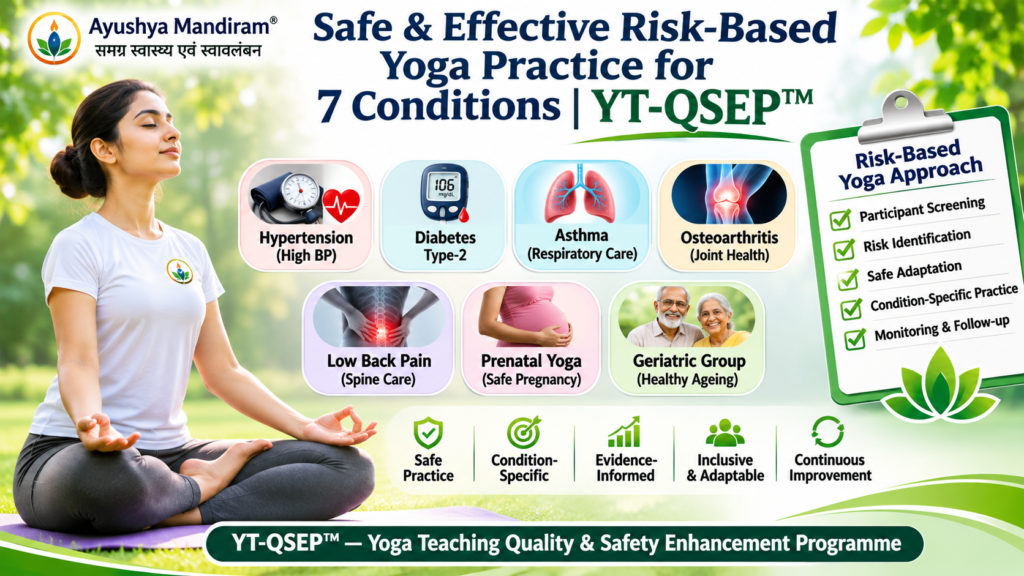
U2-M03: Risk-Based Yoga Practice for 7 Representative Health Conditions
Participant Awareness, Appropriate Adaptation and Safer Teaching
YT-QSEP™ — Yoga Teaching Quality & Safety Enhancement Programme
Module Introduction
Yoga classes may include participants with different health backgrounds, physical capabilities, mobility levels and individual needs. Risk-based yoga teaching requires the instructor to consider relevant information, recognise possible warning signs and make responsible decisions about activity selection, modification, supervision and referral.
This module introduces seven representative health and participant contexts: hypertension, type 2 diabetes, asthma, osteoarthritis, low back pain, pregnancy and geriatric groups. The aim is to strengthen safety awareness and appropriate professional decision-making—not to diagnose or treat medical conditions.
Learning Focus
- Recognise why health context and individual capacity matter when planning yoga sessions.
- Understand the role of appropriate pre-practice screening and participant communication.
- Consider modifications, rest options and the need to stop an activity when concerns arise.
- Identify situations that may require guidance from an appropriately qualified healthcare professional.
- Understand the importance of staying within professional competence and maintaining appropriate records.
Seven Representative Health Contexts
1. Hypertension
Consider the participant’s stated health information, current comfort, activity tolerance and any guidance they have received from their healthcare professional. Avoid assuming that every participant with hypertension has the same needs. Do not prescribe treatment or advise changes to medication.
Teaching consideration: Use clear instructions, allow participants to work within comfortable limits and respond appropriately if they report concerning symptoms.
2. Type 2 Diabetes
Individual circumstances may vary, including activity tolerance and the participant’s own management plan. A yoga teacher should respect information the participant chooses to share and avoid making assumptions about glucose levels, medication or medical stability.
Teaching consideration: Be attentive to reported discomfort or sudden changes in wellbeing, and follow appropriate safety and emergency procedures when required.
3. Asthma
Participants may have different triggers and levels of exercise tolerance. The teacher should be attentive to reported breathing difficulty and avoid treating a yoga session as a substitute for an individual’s prescribed asthma management plan.
Teaching consideration: Respect the participant’s established care instructions and seek urgent assistance if a serious breathing emergency is suspected.
4. Osteoarthritis
Joint comfort, mobility and functional capacity can differ considerably between participants. A movement that is comfortable for one person may not be appropriate for another.
Teaching consideration: Offer appropriate options within your competence, avoid pressuring participants into painful movements and respond to individual feedback.
5. Low Back Pain
Low back pain has many possible causes, and a yoga teacher cannot establish the cause from symptoms alone. A participant’s report of pain should be taken seriously, particularly when symptoms are new, worsening or unusual for that person.
Teaching consideration: Stop or modify an activity when appropriate and recommend suitable professional assessment when the concern falls outside the teacher’s role. Urgent or severe warning signs require appropriate medical attention.
6. Pregnancy
Pregnancy involves changing physical needs, and appropriate activity can depend on the stage of pregnancy, individual circumstances and professional guidance. General yoga instruction should not be presented as a replacement for antenatal care.
Teaching consideration: Respect individual advice from the participant’s maternity-care professional, avoid unsupported assurances of safety and refer questions outside your competence.
7. Geriatric Groups
Older adults are not a uniform group. Mobility, balance, strength, sensory function and health status may differ widely. Age alone does not determine an individual’s ability to participate.
Teaching consideration: Consider the practice environment, accessible movement options, safe transitions and appropriate support without making assumptions based solely on age.
A Common Risk-Aware Teaching Approach
The following is an illustrative educational sequence for considering safety. It is not a clinical assessment tool or a substitute for the programme’s designated screening and safety materials.
- Understand: Listen to the participant’s stated needs and relevant information.
- Check: Use the applicable pre-practice screening process where required.
- Plan: Select activities appropriate to the teaching context and the participant’s demonstrated capacity.
- Adapt: Offer reasonable options and respect the participant’s choice to decline or stop.
- Observe: Pay attention to reported discomfort or concerning changes during practice.
- Respond: Pause, stop, seek assistance or refer as appropriate to the circumstances.
- Document: Record relevant information according to applicable procedures and privacy requirements.
Illustrative Learning Scenarios
Scenario A: A participant reports unusual discomfort
During a class, a participant says that a movement is causing unexpected discomfort. The teacher should take the report seriously, avoid pressuring the participant to continue and decide on an appropriate response within their training and role.
Scenario B: A participant’s needs change
A participant who usually performs an activity comfortably reports that they feel unwell today. The teacher should not assume that previous participation proves the activity is appropriate under current circumstances.
Scenario C: A question requires clinical judgement
A participant asks whether a specific yoga practice is suitable for managing their medical condition. The teacher should explain the limits of their professional role and direct the participant to an appropriately qualified healthcare professional where individual clinical advice is needed.
Professional Boundaries and Documentation
- Do not diagnose a health condition or promise a clinical outcome.
- Do not advise participants to start, stop or change prescribed medication.
- Respect privacy and handle health information through appropriate channels.
- Document relevant observations and actions factually, avoiding unsupported conclusions.
- Follow the applicable screening, referral, incident-reporting and emergency procedures.
- Seek further guidance when a decision exceeds your qualifications or competence.
Questions for Reflection
- Why should two participants with the same health condition not automatically receive identical instruction?
- What is the difference between adapting a yoga activity and providing clinical treatment?
- How should a teacher respond when a participant reports a new or concerning symptom?
- When should the teacher seek guidance or recommend professional assessment?
- Why is it important to avoid making guarantees about health outcomes?
Important Clarification
This page is a general educational introduction. The seven health contexts are listed in the YT-QSEP™ Version 2.0 Master Module Map, but the explanations here are introductory summaries—not condition-specific clinical protocols, contraindication lists or personalised medical advice.
This page does not establish official YT-QSEP™ screening thresholds, prescribed asana sequences or treatment recommendations. Refer to the canonical programme syllabus and designated Student Learning Material for programme-specific learning content and instructions.
Yoga teaching does not replace diagnosis, medical treatment or care from an appropriately qualified healthcare professional.
Enquire About YT-QSEP™
For programme details, current batches, the learning process and applicable fees, contact the programme team directly.
Enquire on WhatsApp