
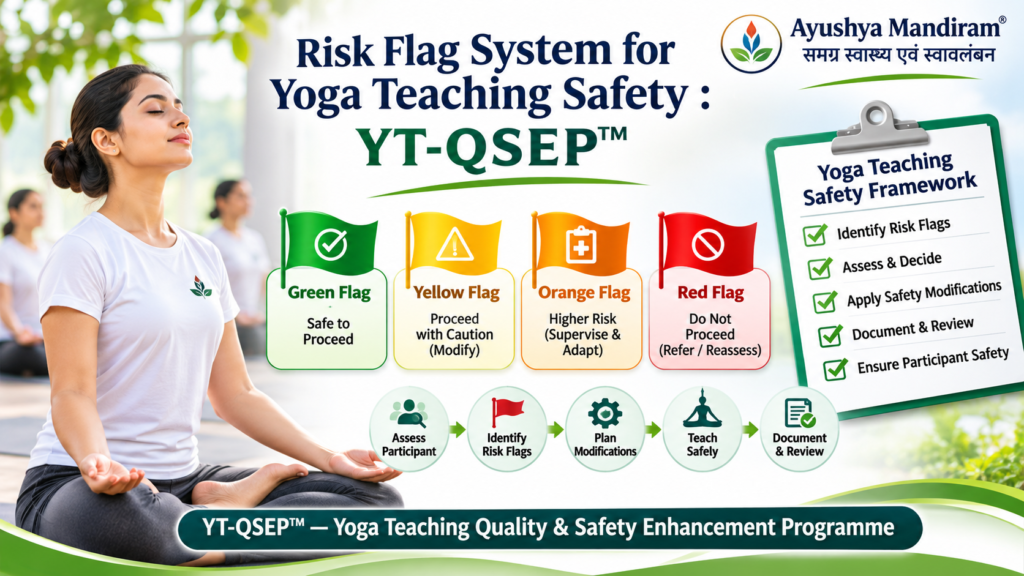
U2-M02: Risk Flag System
Recognising Warning Signs and Supporting Safer Decisions
YT-QSEP™ — Yoga Teaching Quality & Safety Enhancement Programme
Module Introduction
A risk flag is a signal that a situation may need closer attention before or during a yoga session. Risk flags may arise from information shared by a participant, an observed change in their condition, the teaching environment or a concern about whether an activity is appropriate.
Recognising such signals supports informed decisions about whether to proceed cautiously, modify an activity, pause a session, seek assistance or refer a participant to an appropriately qualified professional. A flag is a prompt for responsible attention, not automatically a diagnosis or a confirmed finding of harm.
Learning Focus
- Understand the purpose of identifying risk flags in yoga teaching.
- Recognise the difference between a reported concern and a confirmed conclusion.
- Consider how participant communication and observable circumstances inform safety decisions.
- Identify when an activity may need modification, postponement or cessation.
- Understand the importance of appropriate referral, incident reporting and factual documentation.
Understanding Risk Flags
1. Participant-Reported Concerns
A participant may report pain, dizziness, unusual breathlessness, recent injury, discomfort or concern about performing a movement. The teacher should listen respectfully, avoid dismissing the concern and respond within their training and role.
2. Observable Changes
A sudden change in balance, coordination, responsiveness, breathing or general appearance may indicate that an activity should be paused and the situation assessed appropriately. Yoga teachers should not attempt to diagnose the cause of an observed change.
3. Activity and Environment Risks
Risk signals may also relate to unsuitable equipment, slippery surfaces, insufficient space, unclear instructions, an activity that exceeds a participant’s demonstrated ability or an environment that prevents safe supervision.
4. Professional-Scope Concerns
A request may fall outside the teacher’s qualifications or competence. In such circumstances, the teacher should explain the limits of their role and seek appropriate guidance or referral rather than making unsupported clinical claims.
Responding to a Risk Flag
The response should reflect the nature and apparent urgency of the concern. The following is an illustrative decision sequence, not an official YT-QSEP™ classification or mandatory protocol.
- Notice: Identify the reported concern or observable change.
- Pause: Stop or modify the activity when continuing could be unsafe.
- Communicate: Ask appropriate, non-diagnostic questions and listen to the participant.
- Respond: Follow relevant safety and emergency procedures; seek urgent assistance when indicated.
- Refer: Recommend assessment by an appropriately qualified professional when the concern is outside the teacher’s role.
- Record: Document relevant facts and actions in accordance with applicable organisational and privacy requirements.
- Review: Consider whether the teaching plan or environment needs a safety improvement before the activity resumes.
Illustrative Scenarios
Scenario 1: New discomfort
A participant reports sharp discomfort during a movement. The teacher should not pressure the participant to continue. The activity should be stopped or appropriately modified, with further action guided by the circumstances and relevant safety procedures.
Scenario 2: Unexpected dizziness
A participant reports dizziness after changing position. The teacher should respond cautiously, prioritise immediate safety and seek suitable assistance where necessary. The teacher should not assume a cause or offer a diagnosis.
Scenario 3: Unsafe environment
A teacher notices that the floor is slippery near the practice area. The environmental risk should be addressed before participants are asked to continue in that area.
Risk Flags and Documentation
A useful record should distinguish what was directly observed, what the participant reported, what action was taken and what follow-up occurred. Avoid speculation, unsupported diagnoses and unnecessary personal details.
Where an organisation has established screening forms, escalation routes or incident-reporting requirements, staff should follow the applicable instructions. Records should be handled securely and shared only through appropriate channels.
Questions for Reflection
- Why should a risk flag be treated as a prompt for attention rather than a diagnosis?
- What is the difference between a participant-reported concern and a teacher’s observation?
- When should a yoga teacher stop an activity rather than attempt to modify it?
- Why is it important to know the limits of one’s professional competence?
- How can risk information be documented while protecting participant privacy?
Important Clarification
This page introduces the general concept of risk flags for educational purposes. The examples and response sequence are illustrative; they do not establish official YT-QSEP™ flag categories, colour codes, scoring thresholds, mandatory forms or a validated clinical triage protocol.
Use the canonical YT-QSEP™ syllabus and designated learning materials for programme-specific requirements. This page is not medical or legal advice and is not a substitute for emergency procedures or professional clinical assessment.
Enquire About YT-QSEP™
For programme details, current batches, the learning process and applicable fees, contact the programme team directly.
Enquire on WhatsApp