
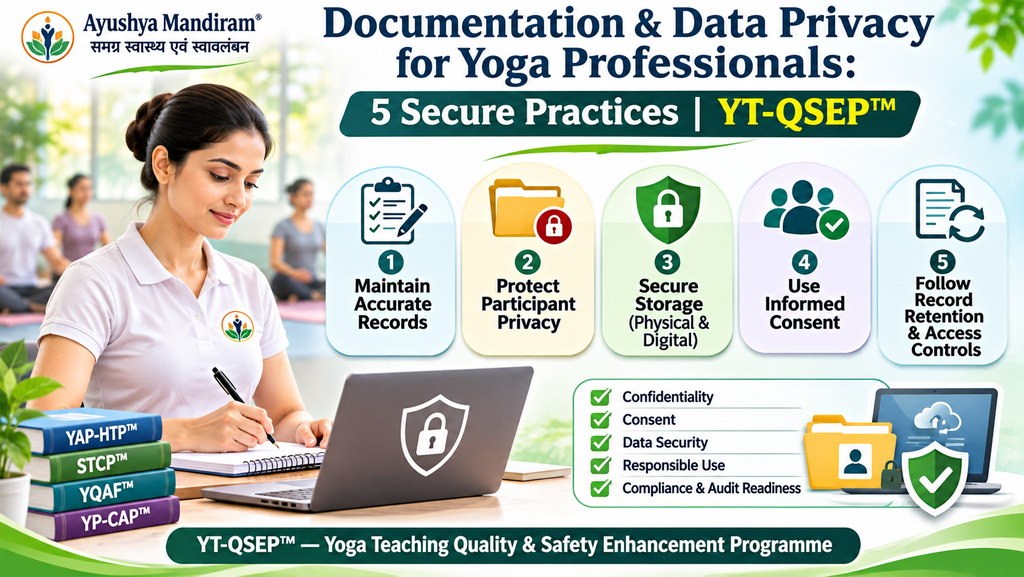
U2-M04: Documentation & Data Privacy
Accurate Records, Confidentiality and Responsible Information Handling
YT-QSEP™ — Yoga Teaching Quality & Safety Enhancement Programme
Module Introduction
Documentation supports continuity, accountability and quality improvement in yoga teaching. Depending on the service and organisational requirements, records may include attendance, relevant participant screening information, consent, session modifications, incidents and follow-up actions.
These records may contain personal or health-related information that requires careful handling. Yoga professionals should understand what information is necessary, why it is collected, who may access it and how it should be protected.
This module introduces responsible documentation and data privacy as complementary parts of safe professional practice. Accurate records support accountability, while appropriate information handling helps protect participant dignity and confidentiality.
Learning Focus
- Understand the purpose of relevant professional records.
- Distinguish factual observations from assumptions and opinions.
- Recognise the sensitivity of personal and health-related information.
- Understand the importance of appropriate access, storage and disclosure.
- Recognise the role of retention, correction and secure disposal practices.
- Understand how documentation supports incident review and continual improvement.
1. Documentation in Yoga Teaching
Documentation is the recording of relevant information about a professional activity, decision or event. Records should serve a clear purpose and reflect what actually occurred.
Examples of records
- Attendance and session participation records.
- Relevant screening information collected through an appropriate process.
- Consent or acknowledgement records where applicable.
- Session modification notes when relevant to safe teaching and continuity.
- Incident reports and records of actions taken.
- Follow-up notes and quality-improvement records.
These examples are illustrative. The records required in a particular setting depend on the service, applicable requirements and established organisational procedures.
2. Principles of Accurate Recordkeeping
Accuracy
Record information carefully and avoid introducing details that have not been established. If a participant reports a concern, distinguish their reported words or account from what the teacher directly observed.
Relevance
Collect and record information that is relevant to the legitimate purpose of the activity. Avoid unnecessary personal details.
Timeliness
Complete records within the applicable timeframe and follow established procedures for reporting significant incidents. Do not delay urgent safety action while completing documentation.
Traceability
Records should make it reasonably clear what happened, what action was taken and who was responsible for the documented action, where such information is necessary and appropriate.
Corrections and amendments
If a record needs correction, follow the applicable process so that the correction does not misrepresent the original event or undermine the reliability of the record.
3. Understanding Data Privacy
Data privacy concerns how personal information is collected, used, stored, shared and otherwise processed. Information relating to a participant’s health may be particularly sensitive in practice, even when collected as part of an ordinary wellness service.
Purpose and transparency
Explain the purpose of collecting information in a manner appropriate to the setting. Information should not be collected or reused for unrelated purposes without an appropriate basis.
Access control
Limit access to records to people who are authorised and have a legitimate need to use them. Avoid sharing participant information casually through personal messaging groups or unsecured channels.
Secure storage
Paper records should be protected from inappropriate viewing, loss or unauthorised removal. Digital records should be protected through appropriate account security, access controls, device safeguards and secure handling practices.
Disclosure and confidentiality
Do not disclose participant information merely because someone asks for it. Check the person’s authority, the purpose of the request and the applicable organisational and legal requirements before sharing information.
Retention and disposal
Retain records according to applicable legal, contractual and organisational requirements. When records are no longer required, dispose of them securely in accordance with the relevant process.
4. Incident Documentation
An incident record should provide a clear, factual account of a relevant event and the response taken. The exact fields and reporting deadlines depend on the applicable organisational process and circumstances.
Information that may be relevant
- Date, time and location of the event, where known and relevant.
- A factual description of what was observed or reported.
- Actions taken in response to the concern.
- Assistance sought or notifications made, where applicable.
- Relevant follow-up actions and the person responsible for them.
An incident record is not, by itself, proof of negligence or a determination of legal responsibility. Its purpose is to preserve a reliable account and support appropriate review.
5. Illustrative Scenario
After a group yoga session, a participant reports discomfort during one of the movements. The teacher records the participant’s reported concern, the activity being performed, the immediate response and any appropriate follow-up. The teacher avoids making a diagnosis and stores the record through the centre’s designated process.
Questions for reflection
- Which details are relevant to an accurate record?
- How should the teacher distinguish reported information from direct observation?
- Who should have access to the record?
- What should the teacher do if asked to share the record with an unauthorised person?
- How can the information be used for an appropriate safety review without unnecessary disclosure?
This scenario is illustrative learning material, not an official YT-QSEP™ incident-reporting form or mandatory procedure.
6. Digital Records and Responsible Handling
- Use authorised systems and accounts for professional records.
- Protect devices and accounts against unauthorised access.
- Verify recipients before sending participant information.
- Avoid placing unnecessary health information in public posts or promotional material.
- Follow established processes for suspected loss, unauthorised access or disclosure.
- Do not assume that a record is secure simply because it is stored digitally.
7. Legal and Organisational Considerations
Information-handling duties depend on the applicable law, the nature of the information, the role of the organisation and the circumstances of processing. Where relevant, organisations should review their responsibilities under India’s Digital Personal Data Protection framework and any applicable rules, commencement provisions and other legal requirements.
A general website introduction cannot establish that every provision applies to every situation at the same time. Institutions should verify the current legal position and obtain appropriate advice where necessary.
Questions for Reflection
- Why should professional records be accurate, relevant and timely?
- What is the difference between a participant’s reported statement and a teacher’s observation?
- Why should access to personal information be restricted?
- How should a teacher respond to a request for information from someone whose authority is unclear?
- Why should incident documentation avoid unsupported conclusions?
- How can good recordkeeping support quality improvement while respecting confidentiality?
Important Clarification
This page is an educational introduction to documentation and data privacy. The examples are illustrative and do not establish an official YT-QSEP™ form, mandatory retention period, access-control matrix or incident reporting deadline.
Refer to the canonical YT-QSEP™ syllabus, designated Student Learning Material and applicable organisational procedures for programme-specific requirements. This page does not constitute legal advice.
Enquire About YT-QSEP™
For programme details, current batches, the learning process and applicable fees, contact the programme team directly.
Enquire on WhatsApp