
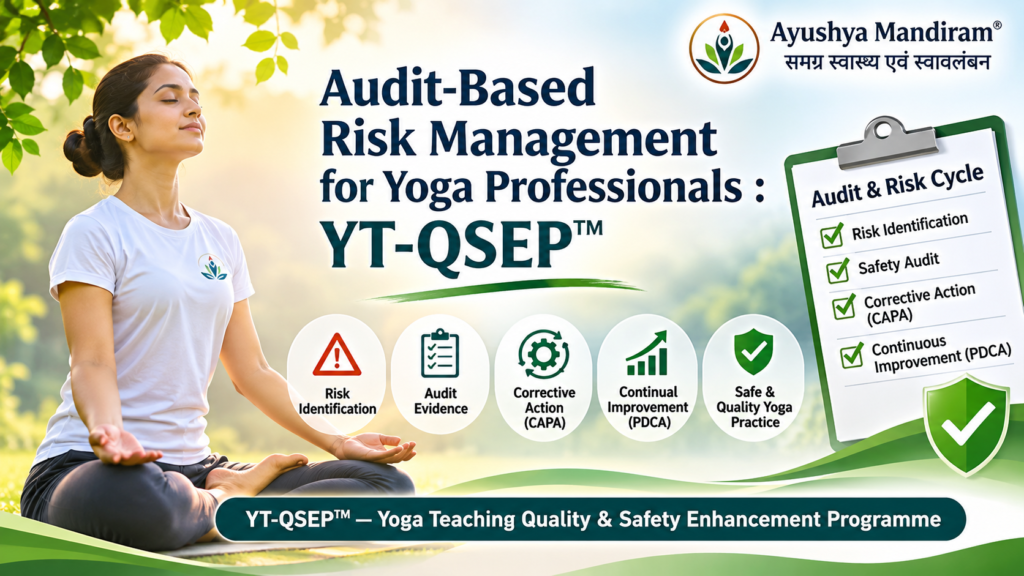
U2-M01: Audit-Based Risk Management
Systematic Review, Risk Identification and Continual Improvement
YT-QSEP™ — Yoga Teaching Quality & Safety Enhancement Programme
Module Introduction
Audit-based risk management is a systematic approach to reviewing how yoga teaching activities are planned, delivered, documented and improved. It helps a yoga professional or institution examine whether established safety practices are being followed, identify gaps and determine what improvements may be needed.
In YT-QSEP™, this topic connects risk awareness with professional responsibility, documented evidence, corrective action and continual improvement. The objective is not merely to find mistakes, but to identify preventable risks and strengthen the reliability of teaching practices.
Learning Focus
This topic introduces learners to the following concepts:
- The purpose of audit-based risk management in yoga teaching.
- The distinction between identifying a risk and documenting an observed finding.
- The use of relevant records and observable evidence during a review.
- The identification of gaps between expected and actual practice.
- The role of corrective action and follow-up in improving safety.
- The importance of objective, proportionate and confidential recordkeeping.
Key Concepts
1. Risk Identification
Risk identification involves recognising circumstances that could contribute to harm, service failure, privacy concerns or other undesirable outcomes. In a yoga setting, examples for consideration may include unclear instructions, inadequate adaptation, incomplete relevant records or an unsuitable response to a reported safety concern.
2. Audit Evidence
An audit should be based on relevant and verifiable information rather than assumptions. Depending on the review’s purpose, evidence may include records, observed practices, documented procedures and appropriately obtained feedback. Personal information should be handled with due care.
3. Findings and Gaps
A finding describes what the review established in relation to the criteria being examined. A gap exists when observed practice does not adequately meet an applicable requirement or defined expectation. Findings should be recorded accurately and supported by evidence.
4. Corrective Action
Corrective action addresses an identified problem and, where appropriate, its underlying cause. A useful improvement process considers what happened, why it may have happened, what needs to change and how the effectiveness of that change will be reviewed.
5. Continual Improvement
Reviewing results, implementing improvements and checking their effectiveness supports a learning-oriented safety culture. An audit is more useful when its findings lead to proportionate action rather than remaining only as a written report.
A Practical Review Sequence
The following sequence is an illustrative learning framework for understanding the logic of a review. It is not presented as an official YT-QSEP™ audit procedure or mandatory form.
- Define: Clarify the activity or process being reviewed.
- Examine: Review relevant practices and available evidence.
- Identify: Record observed risks, gaps and improvement opportunities.
- Analyse: Consider plausible contributing factors without making unsupported assumptions.
- Act: Identify proportionate improvements and assign responsibility where appropriate.
- Review: Check whether the action was implemented and whether it appears effective.
Illustrative Example
During a routine review of yoga class records, an institution notices that documentation of participant modifications is inconsistent. The reviewer records the observation, checks the relevant procedure, and explores whether the issue relates to unclear instructions, record design or staff understanding.
The institution may then consider a proportionate improvement, explain the expected process to relevant staff and review later records to see whether documentation has become more consistent.
This example is illustrative and does not establish an official YT-QSEP™ audit criterion, risk score or corrective-action requirement.
Questions for Reflection
- Why should audit findings be supported by evidence?
- How does risk identification differ from assigning blame?
- What is the difference between correcting an immediate problem and addressing its contributing cause?
- Why should an improvement be reviewed after implementation?
- How can participant confidentiality be protected during a review?
Important Clarification
This page is an introduction to the topic of audit-based risk management. The review sequence and example are illustrative learning material, not a confirmed official YT-QSEP™ procedure, prescribed audit checklist, scoring system or mandatory documentation format.
The complete Student Learning Material (SLM), programme-specific requirements and any formal assessment instructions are provided separately through the designated learning platform and canonical programme documents.
Enquire About YT-QSEP™
For programme details, current batches, the learning process and applicable fees, contact the programme team directly.
Enquire on WhatsApp