
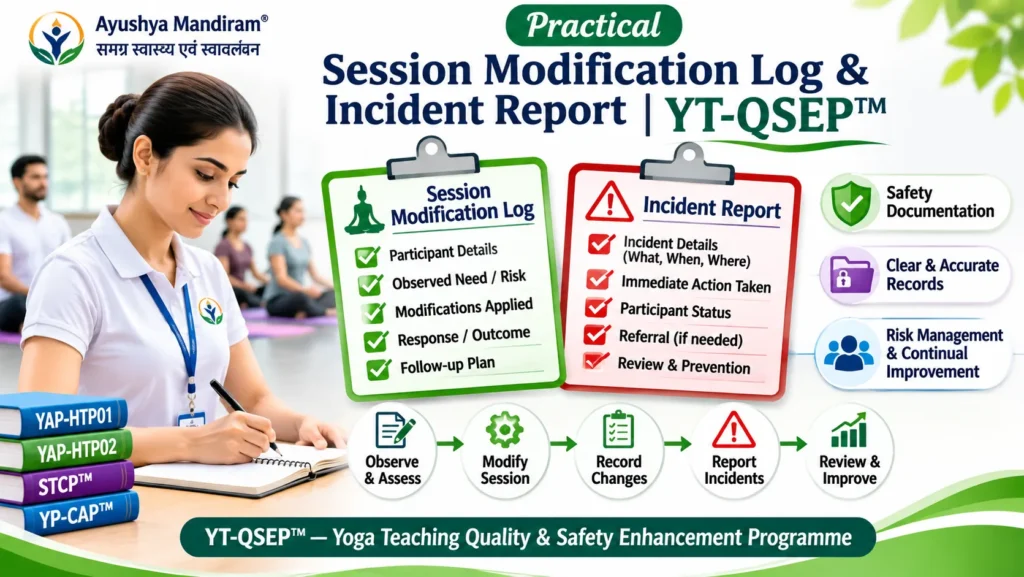
U2-P02: Session Modification Log & Incident Report
Practical Activity — Documenting Adaptations and Incidents
YT-QSEP™ — Yoga Teaching Quality & Safety Enhancement Programme
Activity Introduction
Safe yoga teaching may require changes to a planned activity when a participant’s comfort, demonstrated ability, expressed concern or circumstances call for a different approach. Recording relevant modifications can help explain what was changed and support continuity of teaching.
An incident report serves a different purpose: it records relevant facts about an event and the response taken. Both types of documentation should be factual, proportionate, appropriately protected and consistent with applicable organisational procedures.
The YT-QSEP™ Version 2.0 Master Module Map identifies this activity as YAP-HTP03 Session Modification Log + YAP-HTP05 Incident Report. This page introduces the two concepts; it does not reproduce the official forms or establish mandatory reporting fields.
Learning Objectives
- Understand why a session modification may need to be documented.
- Distinguish routine session adjustments from incidents requiring a separate report under applicable procedures.
- Practise describing relevant facts without unsupported conclusions.
- Understand the importance of appropriate follow-up and escalation.
- Protect participant confidentiality when creating, storing or sharing records.
- Recognise when an official form or institutional instruction must be consulted.
Part A — Understanding a Session Modification Log
A session modification log is a record of relevant changes to a planned teaching activity. For example, a teacher may offer a different movement, reduce the demand of an activity, provide an alternative position or discontinue an activity when continuing may be inappropriate.
Why document a modification?
- To explain the change made during a session.
- To record the relevant participant feedback or observable circumstance.
- To support continuity when appropriate information needs to be reviewed later.
- To help evaluate whether teaching instructions or session planning need improvement.
Illustrative information for a learning record
- Date and session reference, where appropriate.
- Activity or movement being considered.
- Relevant information reported or observed.
- Modification or alternative offered.
- Participant response, where relevant and appropriately recorded.
- Any necessary follow-up or review.
Part B — Understanding an Incident Report
An incident report is intended to preserve a factual account of an event that needs to be recorded under the relevant organisational procedure. The precise reporting requirements depend on the circumstances and the authorised process in use.
Principles of incident documentation
- Describe what occurred using clear, factual language.
- Distinguish what was directly observed from what another person reported.
- Record relevant actions taken and assistance sought.
- Follow the applicable reporting and notification procedures.
- Protect personal information and restrict access appropriately.
- Avoid speculation, blame-oriented language and unsupported diagnoses.
Part C — Why the Two Records Are Different
Session modification log
Focuses on a relevant change to a teaching activity and the circumstances surrounding that change. A modification does not automatically mean that an incident has occurred.
Incident report
Focuses on a reportable event and the actions taken in response, according to the applicable procedure. Whether a particular event must be reported should be determined from the authorised instructions, not guessed.
Part D — Illustrative Practice Scenario
During a group session, a participant reports discomfort while performing a planned movement. The teacher stops the activity for that participant and considers an appropriate alternative within their competence. The participant’s concern is taken seriously, and the teacher follows the relevant safety process.
Later, the teacher needs to document the modification and determine whether the circumstances also meet the organisation’s criteria for an incident report.
Discussion questions
- What information is relevant to the session modification?
- What should be recorded as a reported statement rather than a direct observation?
- What additional information would be needed to determine whether an incident report is required?
- Which authorised form or procedure should be consulted?
- How should the records be stored and access controlled?
This scenario is fictional and educational. It is not an official YT-QSEP™ case, approved reporting rule or determination of negligence.
Part E — Suggested Learner Reflection
The following prompts may be used during facilitated learning. They are not official YAP-HTP03 or YAP-HTP05 forms.
1. Situation
What relevant event or teaching circumstance was considered?
2. Action
What action was taken, and what was the reason for it?
3. Source verification
Which authorised procedure or form was consulted, if available?
4. Follow-up
Was any follow-up identified under the applicable process?
5. Privacy
How was unnecessary disclosure of participant information avoided?
Part F — Record Quality and Data Privacy
- Use factual, clear and relevant language.
- Do not add an unverified diagnosis or assume the cause of an event.
- Follow the authorised process for corrections or amendments.
- Use designated systems and appropriate access controls.
- Share records only with authorised recipients for an appropriate purpose.
- Follow applicable retention, security and incident-reporting requirements.
If a record contains personal or health-related information, handle it in accordance with applicable privacy requirements and the institution’s authorised procedures.
Important Disclaimer and Source Limitation
This webpage is an introductory educational resource for U2-P02. It does not reproduce or establish the official YAP-HTP03 Session Modification Log or YAP-HTP05 Incident Report.
The example fields, reflection prompts and fictional scenario are illustrative only. They must not be treated as mandatory official form fields, reporting deadlines, severity classifications, assessment criteria or approved institutional procedures.
The applicable official forms, instructions and reporting criteria must be verified against the authorised, current programme documents. Where a field, threshold or procedure cannot be verified, it must remain unspecified rather than being invented.
This page does not provide medical or legal advice and does not determine whether an event constitutes negligence or a legally reportable incident. Follow applicable emergency procedures and seek appropriate professional guidance when required.
The complete Student Learning Material (SLM) and formal programme instructions are provided separately through the designated learning platform. This webpage is not a substitute for those materials.
Enquire About YT-QSEP™
For programme details, current batches, the learning process and applicable fees, contact the programme team directly.
Enquire on WhatsApp